
Staying Calm When Work Speeds Up A Gentle Guide to Clarity and Steadiness

Busy periods at work can make even simple tasks feel harder.
A message comes in while you are finishing something else. Someone asks for a quick update. A deadline moves closer. A small decision suddenly feels heavy. You may notice your shoulders tighten, your patience shorten, or your thoughts start to race.
This does not mean you are bad at your job. It does not mean you are too sensitive. It often means your mind and body are trying to keep up with more input than they can calmly sort in the moment.
When work speeds up, calm can feel like the first thing to go. But calm is not a personality trait that some people have and others do not. It is a state you can return to, often through small and steady practices.
This guide looks at why we lose our calm when work gets fast, and how to begin finding steadiness again.

Work feels faster when attention gets split
A busy day is not only about having more to do.
It is also about having more things pulling at your attention. Tasks, messages, decisions, family needs, errands, and unfinished thoughts can all compete for space in the mind.
When attention gets split, the brain has to keep switching. Each switch takes energy. Even if each task is small, the repeated switching can leave you feeling scattered.
You might notice this when you:
Open one message and remember three other things
Start a task, then stop to answer a question
Read the same sentence several times
Feel irritated by something that would usually not bother you
Lose track of what matters most
This is one reason a fast-paced work environment can feel more draining than the actual workload suggests. The pace is not only outside you. It begins to live inside your attention.
When everything seems urgent, the mind can stop sorting clearly. It reacts before it reflects.
That is often where calm begins to slip.
The body reads speed as pressure
The body is always listening.
When the workday speeds up, your nervous system may read that speed as pressure. This can happen even when there is no true danger. The body does not always know the difference between an urgent email and a real threat. It simply notices demand.
Your heart rate may rise. Your breathing may become shallow. Your jaw may tighten. Your thoughts may become faster and narrower.
This is a natural stress response. It prepares you to act. In short bursts, it can help you focus. But when it stays active for too long, it can make calm thinking harder.
You may become more reactive. You may rush decisions. You may speak more sharply than you intended. You may feel like every small delay is a problem.
This is not a personal failure. It is biology doing what biology does.
The challenge is that modern work can keep the body in this alert state for long stretches. There may not be a clear start and stop. There may be no moment when the body receives the message, “We are safe now. We can slow down.”
That message often has to come from you.
Not as a command. Not as forced positivity. More like a gentle signal.
A breath. A pause. A choice to name what is happening.
We lose clarity when everything feels equally important
Many people do not lose calm because they are unwilling to work hard. They lose calm because they cannot tell what deserves their attention first.
When everything feels equally important, the mind has no clear path.
A team leader may be trying to support others while also protecting their own focus. A parent may be moving between work tasks and home responsibilities. An early-stage entrepreneur may be carrying sales, service, planning, and problem solving all at once.
The issue is not only busyness. It is unclear priority.
Without priority, the day becomes a set of open loops. Each loop asks for attention. The result can be a low, constant pressure that follows you from one task to the next.
This is where emotional clarity at work becomes useful. It helps you notice what is happening inside you, while also seeing what the moment actually requires.
Clarity does not remove all stress. It helps you stop adding extra stress through confusion, self-blame, and mental clutter.

A simple pause can restore some space
One of the most useful tools for staying calm under pressure is a short pause.
Not a long break. Not a retreat from responsibility. Just a few seconds to interrupt the rush.
Try this when you feel yourself speeding up:
Put both feet on the floor.
Let your shoulders drop slightly.
Take one slow breath in.
Exhale a little longer than you inhale.
Ask, “What is the next useful step?”
This can take less than 30 seconds.
The point is not to become perfectly calm. The point is to create a small space between the pressure and your response.
That small space matters.
It can keep you from sending the message too quickly. It can help you notice that you are tired or hungry. It can remind you that one task needs your full attention more than five half-started tasks do.
You can use this pause before:
Replying to a tense message
Joining a difficult conversation
Choosing what to work on next
Moving from one role to another, such as work to parenting
Ending the day, especially if your mind is still racing
The pause is simple, but it is not always easy. Fast work can make stillness feel unproductive. Yet a pause can be one of the most practical choices you make, because it helps you return with more steadiness.
A short priority reset can reduce the noise
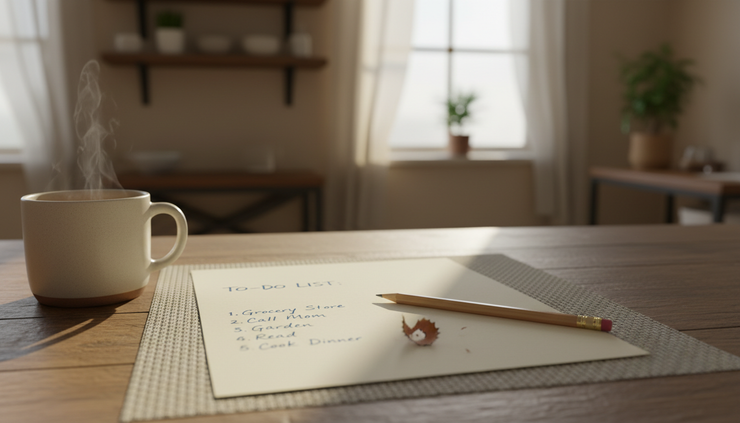
When the mind feels crowded, writing things down can help.
A priority reset is not a full planning session. It is a short way to move thoughts out of your head and onto a page.
Here is one version.
Take three minutes and write down everything that is asking for your attention. Do not sort it yet. Just list it.
Then mark each item with one of these:
Now
This truly needs attention today.
Next
This matters, but it does not need to happen immediately.
Later
This can wait or be revisited.
Not mine
This belongs to someone else, or it needs a clearer request before you carry it.
This practice can be especially helpful for managing stress at work because it separates pressure from priority.
Pressure says, “All of this is urgent.”
Priority says, “This is the next thing.”
There is a difference.
A priority reset helps you see that difference when your mind is too full to hold it clearly.
If your list still feels too large, choose one next step that can be completed in 10 to 20 minutes. A short action can restore movement without asking you to solve the whole day at once.
For example:
Draft the first three lines of the reply
Review one document section
Send one clarifying question
Put the next appointment on the calendar
Close the tabs you are no longer using
A calm workday is not always a slow workday. Often, it is a day where the next step is clear enough to take.
Calm also depends on the stories we tell ourselves
Speed often brings an inner story with it.
Maybe the story sounds like:
“I should be handling this better.”
“Everyone else seems fine.”
“If I slow down, I will fall behind.”
“I cannot make a mistake.”
“I have to answer everything right away.”
These thoughts can feel true in the moment. They may also increase the pressure.
A helpful question is, “Is this thought making the next step clearer?”
If the answer is no, try a more grounded sentence.
For example:
“I should be handling this better.”
“I have to answer everything now.”
“I cannot slow down.”
“I am failing at this.”
“This is a lot, and I can choose one next step.”
“I can respond in order of importance.”
“A short pause may help me work more clearly.”
“I am under pressure, and I can steady myself.”
This is not about pretending everything is fine. It is about speaking to yourself in a way that helps rather than harms.
Self-criticism often feels like control, but it usually creates more tension. A calmer inner voice can support better judgment.
That matters when work is moving quickly.
Small boundaries help the mind recover
Calm is harder to keep when there is no edge to the workday.
Many people move from task to task without a clear stopping point. Even after the laptop closes or the last message is sent, the mind keeps working.
Small boundaries can help.
They do not need to be rigid. They only need to be clear enough for your mind and body to notice.
You might try:
A two-minute end-of-day note with tomorrow’s first task
A short walk before returning to home responsibilities
A set time to check messages instead of constant checking
A quiet breath before opening the next app or inbox
A simple phrase at the end of work, such as “This is enough for today”
The phrase may feel small. But repeated over time, small cues can teach the body when to release some of the pressure.
For working parents, team leaders, and business owners, boundaries may look imperfect. That is normal. The goal is not a perfect routine. The goal is a few reliable cues that help your system shift gears.
When calm returns, it may return quietly
Many people expect calm to feel obvious.
They imagine a sudden sense of peace or complete control. But in real work life, calm often returns in smaller ways.
You may notice that your breathing is less tight. You may read the message more clearly. You may choose not to react right away. You may remember to drink water. You may ask for clarification instead of guessing.
These are signs of steadiness.
They count.
A helpful way to measure progress is not, “Did I stay calm all day?” That standard is too high for most real days.
A better question is, “Did I notice sooner, and did I return more gently?”
That is a kind and practical measure.
It leaves room for being human.

A gentle next step
If this topic feels close to your experience, you are not alone.
Many capable people lose their calm when work speeds up. They may look composed on the outside while feeling crowded and tense inside. This is common, especially when responsibilities overlap and the pace stays high for too long.
If you would like to explore this more, there is an upcoming workshop on emotional steadiness and clarity in busy work seasons. It will offer simple practices for noticing pressure earlier, returning to yourself more gently, and making clearer choices in the middle of demand.
You can learn more here: explore the emotional clarity workshop.
Calm does not have to mean being untouched by pressure. It can mean recognizing what is happening, giving yourself a moment, and choosing the next step with a little more care.
Some days, that is enough.
And if you lose your calm again, that is normal too. You can begin again with one breath, one pause, and one clear next step.


Comments